
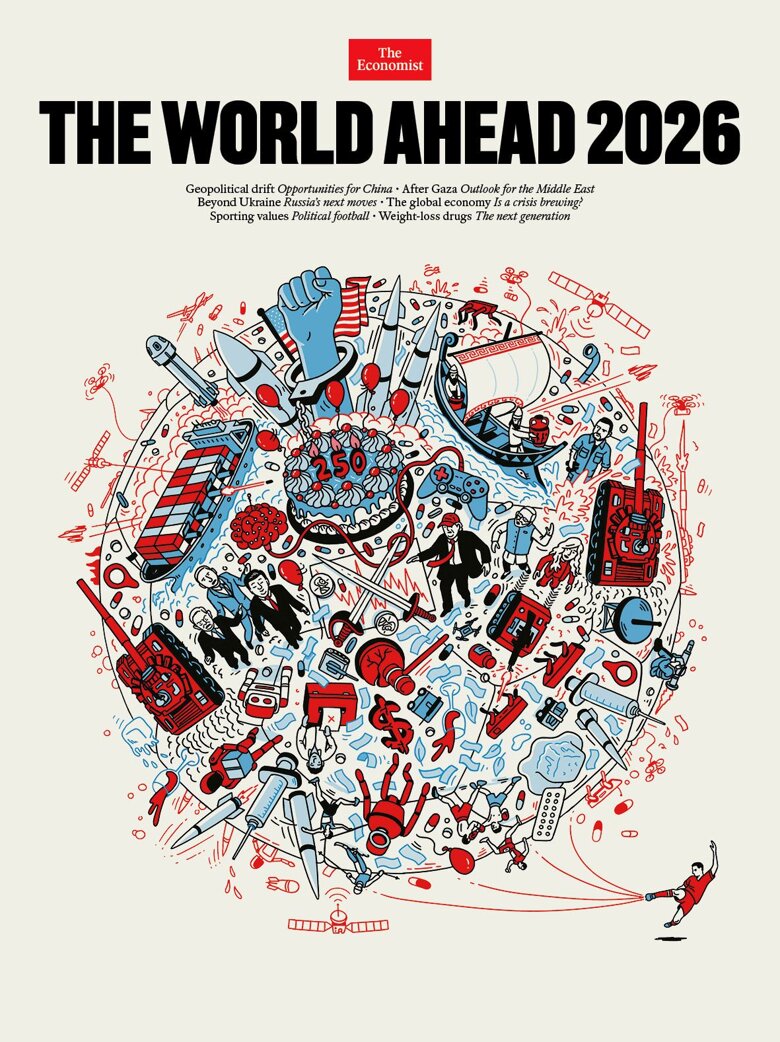
In a world where information ages faster than we can process it, there remains one publication that people still await like a prophetic vision. This is the annual special issue by The Economist — “The World Ahead”, famous for its multilayered covers that do not merely illustrate the future but encode it. The edition stands somewhere between analytics and the art of forecasting. More than once, these covers have proved uncannily accurate: predicting global crises, emerging trends, political shifts, and even technological breakthroughs.
The cover of “The World Ahead 2026” has become one of the most symbolically saturated in recent years. It intertwines politics, war, medicine, technology, global markets, and social shifts into a single composition — vivid, almost festive, yet densely packed with warning signs. At first glance, it may appear chaotic, but every element reflects a real process, threat, or development expected to shape the year 2026.
Political Figures: Faces of a World in Transition
Several key global leaders appear on the cover — each intentionally placed.
Donald Trump is depicted as a figure who has returned to the center of world politics and once again influences the global order.
Beside him is Xi Jinping, whom The Economist continues to portray as one of the world’s most powerful strategists.
Narendra Modi, India’s prime minister, symbolizes the rising influence of Asian powers and the shift of the global center of gravity from West to East.
Particularly notable is the presence of Volodymyr Zelenskyy. His appearance signals that the war in Ukraine remains one of the major sources of global tension. It affects energy markets, NATO strategy, Europe’s defense economies, and the development of new military technologies. His image represents an unfinished conflict and the ongoing fight for a new security architecture.
The presence of Vladimir Putin reflects the reality that Russia remains a “nodal point” in global instability. It highlights the complex geopolitical landscape in which some states still rely on force, authoritarianism, and imperial aspirations.
Colors That Speak Louder Than Words
Although the cover is crowded with symbols, the color palette is striking. The contrast between bright and more subdued tones creates the feeling of a world standing at a crossroads: full of potential yet overshadowed by risk. Red hints at conflict, blue at the cold rationality of geopolitics and diplomacy.
Medical Symbols: A New Era of Biotechnology
Syringes, pills, and ampoules are clearly visible. These symbols do not reference past pandemics — they point to a medical revolution already underway.
The year 2026 is expected to become a turning point for biotechnology, particularly for GLP-1 drugs, which have already transformed treatments for obesity and diabetes. Their impact will extend far beyond medicine — influencing food consumption habits, the fast-food industry, fashion, and beauty standards.
The syringes also represent the shift from mass medicine to personalized healthcare, where drugs designed with the help of artificial intelligence will be tailored to each individual. This marks the beginning of a new digital bio-era.
The “250” Cake: A Celebration Full of Questions
The festive cake with the number 250 refers to the upcoming 250th anniversary of the United States’ independence, celebrated in 2026. But it’s more than a celebratory symbol — it is a question mark about America’s future. Will this milestone be a moment of unity or a reflection of deep political division?
Ships and Sea Routes: The Post-Crisis Global Economy
The large ships on the cover symbolize trade, supply chains, and the struggle for geo-economic influence.
After the pandemic, the war in Ukraine, and rising U.S.–China tensions, global trade is undergoing a massive restructuring.
The year 2026 will push companies toward safer, more distributed, and technologically protected logistics systems.
The ships hint at intensifying competition over sea routes and the rise of pragmatic economic alliances.
Artificial Intelligence: The Main Character Who Isn’t Drawn
There are no robots or microchips on the cover — and this is the most meaningful detail.
Artificial intelligence has become the invisible background of all global processes, the new electricity of the 21st century: unseen, yet powering everything.
In 2026, AI will:
influence the course of wars through autonomous systems,
accelerate drug development,
shape politics through massive data analytics,
restructure labor markets,
redefine educational systems,
and change daily life.
AI is the unseen but central character of the cover.
Papers in the Air: Money, Documents, and Decisions
The flying sheets of paper symbolize:
- international agreements,
- national budgets,
- reforms,
- economic programs,
- and the global election cycle of 2026.
They suggest that the coming year will be rich in documents that rewrite the rules of world politics.
Trends That Will Change Our Lives
Taken together, the elements reveal that 2026 will be a year of transformational shifts:
- Politics will become more technological.
- Medicine — more personalized.
- The economy — more automated.
- Social values — more flexible.
- Wars — increasingly digital.
- Artificial intelligence — omnipresent.
Most importantly, these changes will affect every individual: how we work, how we seek healthcare, how we learn, and how we plan our futures.
The cover of The Economist is not just an image. It is an invitation to think: are we ready for the world that lies ahead — a world where human choices and artificial intelligence intertwine more closely than ever?


